

Nature Seychelles’ CORAL and ARC facilities on Praslin Island were a bee-hive of activity this week as enthusiastic coral practitioners jumped into the exciting world of micro-fragmentation.
“It’s been a long time coming and we are thrilled to share it with our colleagues in Seychelles, Mauritius, and Rodrigues working to save our reefs,” says Dr Luca Saponari from Nature Seychelles’ Reef Rescuers team.
He and 14 others learned and trialed the coral-cutting technique in an intensive 5-day masterclass led by Dr David Vaughan, CEO of Plant a Million Corals and the innovator behind micro-fragmentation.

The training was organized by the Nature Seychelles in collaboration with UNDP and the Government of Seychelles, and drew the participation of organisations in Seychelles and Mauritius that are implementing the regional coral reef restoration project. The Coral Reef Restoration Project is funded by the Adaptation Fund.
Dr. Vaughan introduced the micro-fragmentation technique to the coral restoration practitioners and researchers on Monday and Tuesday. His presentation included a brief overview of the technique’s history, an explanation of its processes, and a discussion on how it has transformed coral reef restoration practices.
The technique involves slicing a piece of coral into tiny fragments of just a few polyps using specialized band saws. These tiny fragments are then placed on trays and set up in land-based nursery tanks where the conditions are just right for them to thrive. Once they grow, they can either be re-fragmented to create even more corals or moved out to the reef. Interestingly, when fragments from the same coral colony are positioned close to each other, their edges grow, touch, and merge into a larger colony.
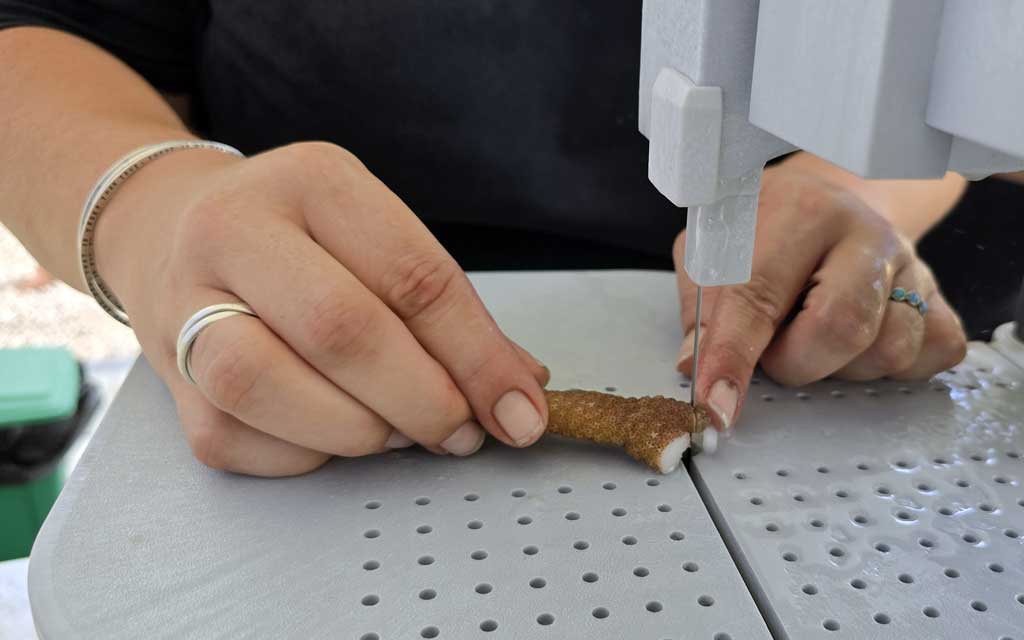
The benefits of this method for restoring coral reefs are numerous. Not only does it allow for the rapid propagation of thousands of corals from just one donor colony, but it also enables scientists to work with slow-growing, massive coral species that are crucial for the reef’s structure but haven’t typically been included in ocean nurseries. It boosts the diversity and resilience of reefs, giving corals a fighting chance against climate change and other environmental challenges.
Participants eagerly tried the technique, generating a thousand coral fragments from previously collected coral species.
“It is quite amazing,” remarked Melanie Ricot from the Reef Conservation NGO carrying out coral reef restoration in the southeast of Mauritius. “Normally a fragment yields about 5 pieces for the nursery, but we’ve obtained hundreds today.” Aishah Fanchette, the project leader on Curieuse Island for the Seychelles Parks and Garden Authority restoration project, echoed this enthusiasm, stating, “It’s super interesting, and I have picked it up quite quickly!”
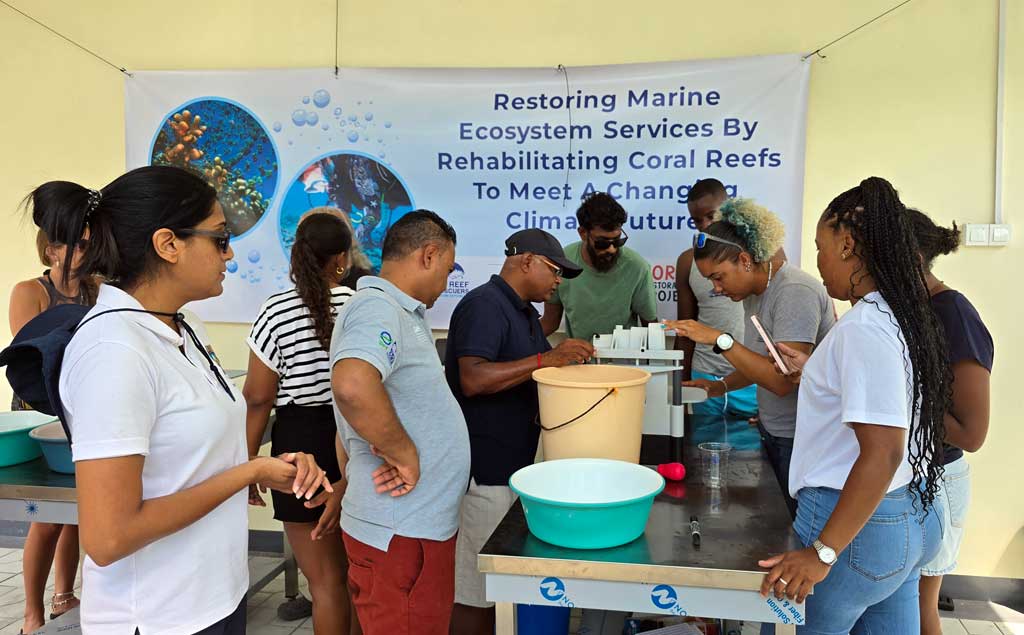
Dr Vaughan expressed his joy at the participants’ energy and enthusiasm. “This is one of the most exciting trainings I have conducted because they are keen to make a difference. I am delighted to share these new tools to amplify their impact. Our Plant a Million Corals foundation aims to have a global impact so that we can turn the tide for coral reefs at speed and at a larger scale,” he said.
The training brought together representatives from Nature Seychelles, Seychelles Parks and Gardens Authority, MCSS, Shoals Rodrigues, Ecosud, Reef Conservation, Marine Academy and Research Centre, Albion Fisheries Research Centre, Mauritius Oceanography Institute, and the Blue Economy Research Institute-University of Seychelles.
It ended with certificate presentation and a field trip to Cousin Island special Reserve where Nature Seychelles is carrying out the restoration.