
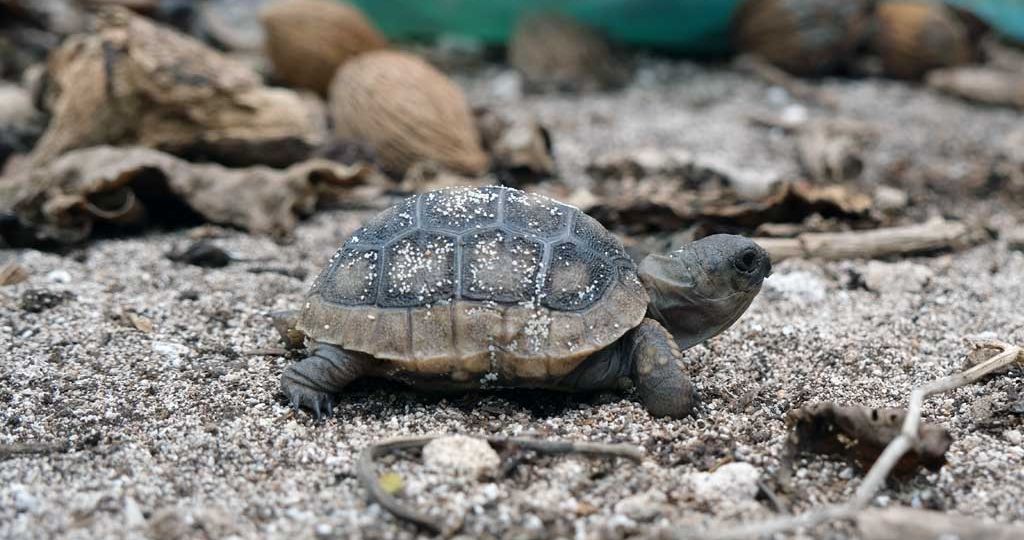
Thirteen Aldabra giant tortoise hatchlings have emerged from a nest incubated under controlled conditions on Cousin Island Special Reserve. The result offers a hopeful sign after several years of declining hatching success in the wild.
Cousin Island science officer Chris Tagg incubated the nest to find out whether conditions at natural nesting sites – including the fine soil tortoises typically nest in – might be affecting hatching. So far, 13 of the 18 hatchlings have emerged, and all are feeding and moving around normally.
The outcome is a stark contrast to the team’s field observations. Of 15 monitored nests, containing more than 100 eggs combined, only one hatched partially. The eggs showed no visible signs of development.
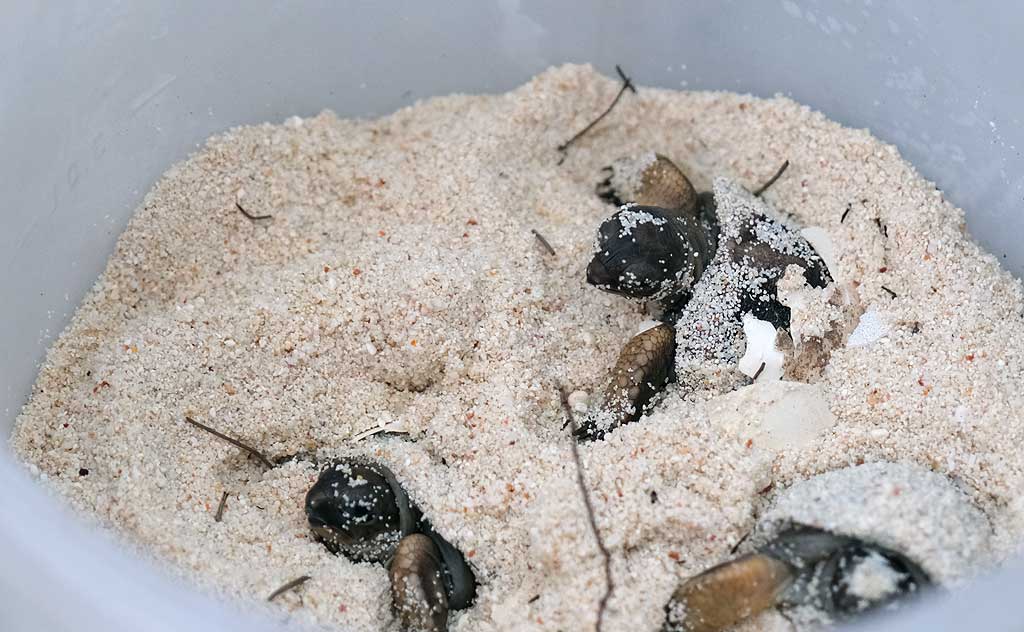
13 Hatchlings emerged from the controlled experiment
“Here on Cousin Island, we have monitoring programmes for all the wildlife -birds, turtles, tortoises, everything. When we see something going wrong, we investigate,” says Tagg. “In the past few years, we’ve monitored more than 15 tortoise nests. Only one hatched successfully, in the sand.”
Working with Seychellois researcher, Alessia Lavigne, the team sought answers.
Alessia’s research focuses on egg failure in turtles and tortoises. See published paper “Understanding Early Reproductive Failure in Turtles and Tortoises” (https://zslpublications.onlinelibrary.wiley.com/doi/10.1111/acv.12986).
For her research, she collected egg samples from tortoises and sea turtles on Cousin Island and elsewhere in Seychelles. Using a specialised microscopic technique, she confirmed that the eggs had been fertilised.
“She was able to show us that our eggs did contain sperm, so they were fertilised and there were embryonic cells there suggesting, yep, fertilisation’s happened, there has been some development, but then nothing after that,” Tagg says
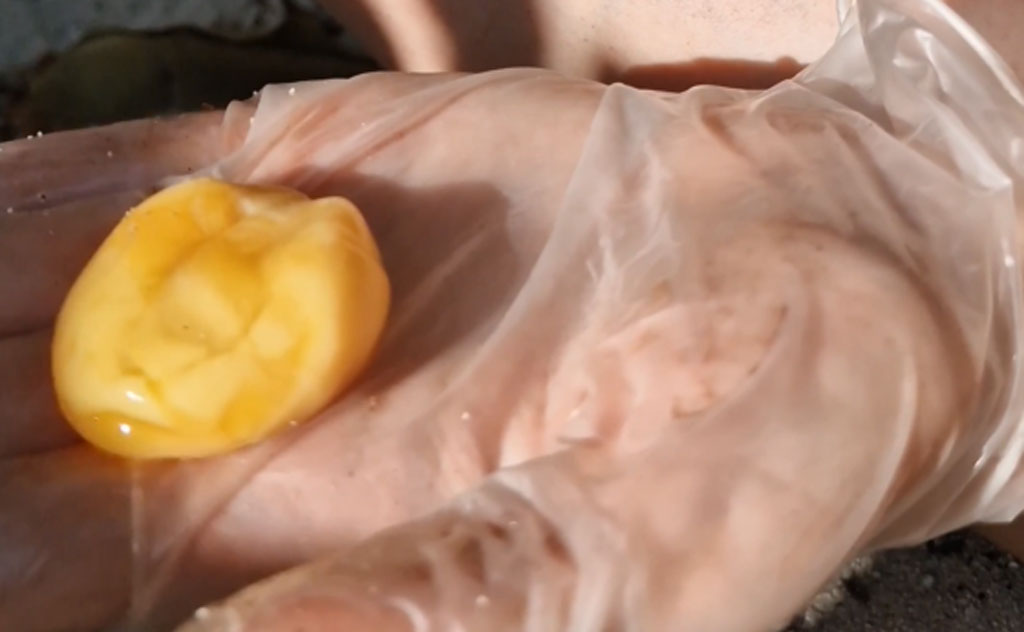
For her research, Alessia collected egg samples from tortoises (Photo: Alessia Lavigne)
“One theory for the failure was the soil. The nests are often laid in very fine, compact soil – almost like concrete – which may stop oxygen from reaching the eggs. Without enough oxygen, the embryos can suffocate.”
“So, to test this theory we carefully collected and moved the 18 eggs from one nest into a controlled hatchery. We adjusted the soil mixture and monitored the environment to see if we would finally have some success. And, they hatched and healthy, and showing all the right behaviours. It suggests that environmental factors, including the soil, could be contributing to the high failure rates, but we will continue to investigate this.”
Taken together, the findings show that the eggs can develop and hatch in suitable conditions. They also highlight the need for continued monitoring to understand what may be affecting tortoise reproduction on the island.