
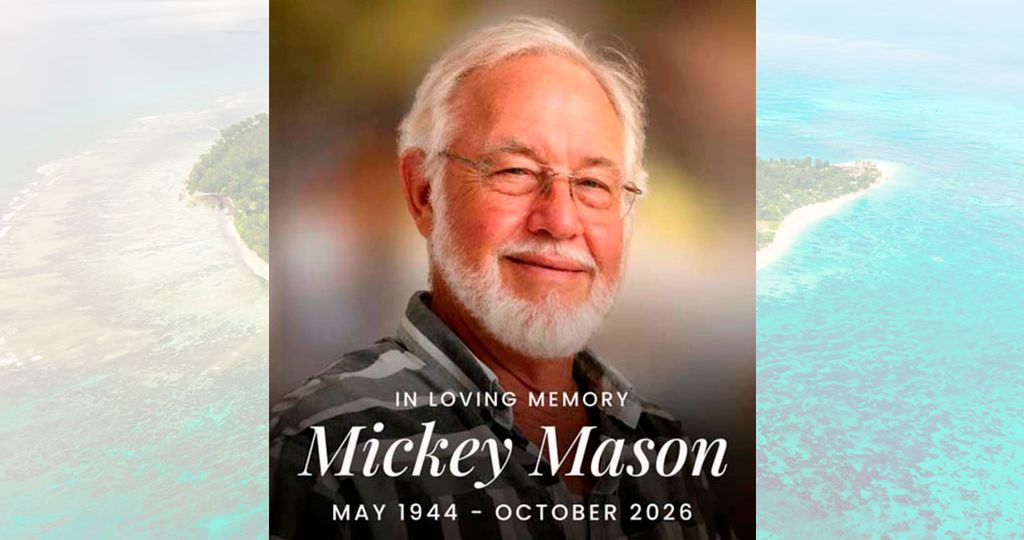
By Dr Nirmal Jivan Shah
My first memories of Mickey Mason, as we knew him, are of laughter and teasing. I was still a boy when he became a familiar visitor to our home. He loved my dad’s potato curry, his famous gato piman or chili cakes, and the Jivan’s ice cream made in the factory downstairs. Despite their difference in age, he and my father became very close friends.
Mickey had returned from Britain as the first fully qualified Seychellois forester. In those days, forestry and conservation in Seychelles were closely bound together. He was passionate about nature and the sea, and I believe that was what drew him and my father together. Dad was an avid conchologist known internationally for his knowledge of the shells of Seychelles and the Western Indian Ocean. There was always plenty for them to talk about. And to joke about.
On some Sundays, we went out in my father’s boat to explore the coral reefs around Mahé, especially the waters that would become the Sainte Anne Marine National Park. Mickey was also a keen sailor. I remember him and Dad racing their little sailing dinghies at regattas. Through all those years, Mickey was forever pulling somebody’s leg.
My father was his best man when he married Kathleen, who remained the love of his life. Dad knew both families well, and I saw Mickey and Kathleen often. I recall when they bought Le Cerf their first tourism boat Mickey took my dad and I on it. He teased the skipper mercilessly about the small seat that wouldn’t fit his bottom.
Years later, when their younger daughter returned to Seychelles as an artist, I was Director of Conservation and National Parks. I believe I gave her her first commission: designing posters for Sainte Anne Marine Park. Mickey telephoned me afterwards, delighted. He had worked in the marine park himself, and it meant a great deal to him that her first commission should be for the environment. I remember the pleasure in his voice.
When my father died suddenly, the shock was felt by many people in Seychelles and all over the world. He had been much loved, and many wanted to speak at his funeral. I chose only a few. Mickey was one of them. He had shared enough of Dad’s life to speak about him as a close friend, and he recalled things I had forgotten or never known. Among them was my father’s involvement in football, first as a player and later as a team manager. I believe Mickey had been a keen footballer too. Even at that painful moment, he gave me something more of my father to remember.
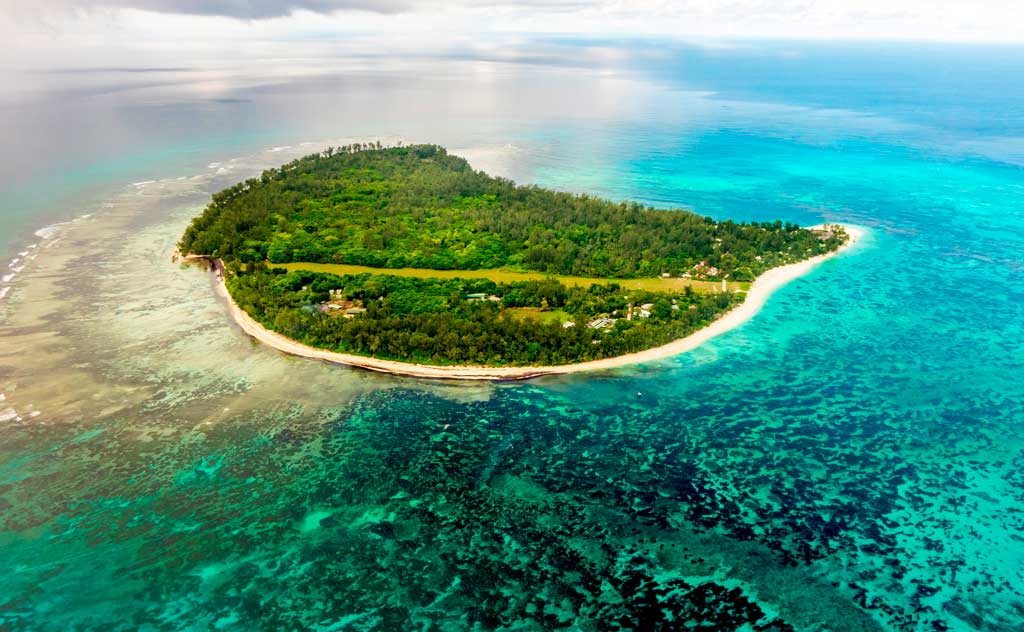
Denis Island Private (Photo : https://denisisland.com/)
After Mickey and Kathleen bought Denis Island and made their home there, I saw less of him. Our work to save Seychelles’ endangered birds eventually brought us together again.
Nature Seychelles began as BirdLife Seychelles, working to rescue some of Africa’s most threatened birds. The Seychelles magpie robin, paradise flycatcher and scops owl were among them. The warbler’s survival had already prompted the purchase of Cousin Island in 1968. With support from the Royal Society for the Protection of Birds, we were working on the magpie robin, but I wanted us to bring these efforts together in a wider bird recovery programme.
I wrote funding proposals, and our first medium-sized Global Environment Facility project began in 1999. A second GEF project, which I developed with an RSPB colleague, helped us continue restoration on private islands. The intention was to establish new populations of threatened endemic birds on islands whose owners could eventually take responsibility for their conservation.

Nature Seychelles was working to rescue threatened birds including the Seychelles Magpie Robin
We carried out an extensive island assessment programme and published the results. Denis emerged as a promising site because of its size, isolation and the opportunity to work with its owners. We examined the birds’ habitat needs, including water availability for the flycatcher. But considerable restoration lay ahead. Much of Denis was crowded with coconut palms, and it had none of the endemic land birds we hoped to establish there.
When I approached Mickey and Kathleen, I expected questions from Kathleen about what we were proposing. I was less prepared for resistance from Mickey, whose conservation background I thought would make him easy to convince.
His objection turned out to concern the Seychelles fody. It was a cheeky bird, he said. It would come to the tables and steal the tourists’ food. They were running a five-star resort, and he was not sure he wanted such badly behaved guests.
“They’re cheeky like you, Mickey,” I told him.
He laughed and slapped me on the back. We went ahead.
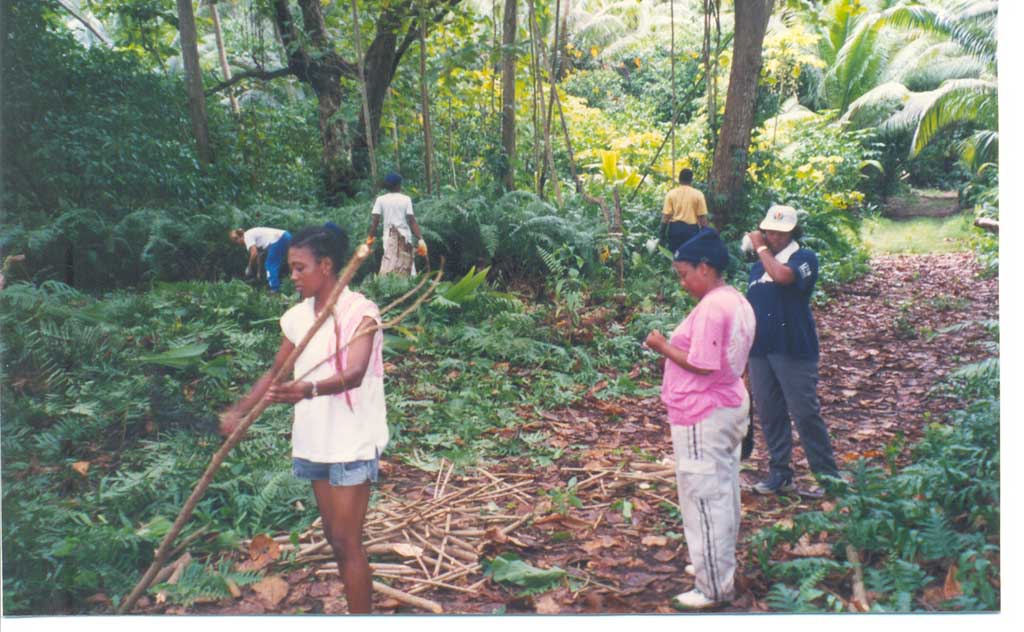
Denis Island Restoration work (Photo: Nature Seychelles' archives)
The restoration was long and arduous. We removed many coconut palms to make room for native woodland. Mickey did not want every coconut tree cut down, but he appreciated the extensive native tree nursery we established and the replanting that followed. Before birds could be moved, the introduced rodents had to go. Mickey and Kathleen paid for the eradication themselves. Alongside owners of islands such as Frégate, they were among the early private-island owners prepared to make that investment in conservation.
Seychelles fodies arrived first, in February 2004, followed by warblers from Cousin later that year. Magpie robins were brought to Denis in June 2008, and paradise flycatchers followed that November. Bringing the paradise flycatcher there presented another difficulty. People on La Digue were deeply attached to their Vev and reluctant to see birds moved away, especially to a privately owned island. Through a further project with the Durrell Institute of Conservation and Ecology at the University of Kent, we spent more than a year on education and advocacy to gain community support on La Digue.
Kathleen graciously offered to host a couple of day visits for community leaders from La Digue so they could see how the birds were being looked after once they had moved. That willingness to welcome people and let them see for themselves helped address understandable concerns about the birds’ future.
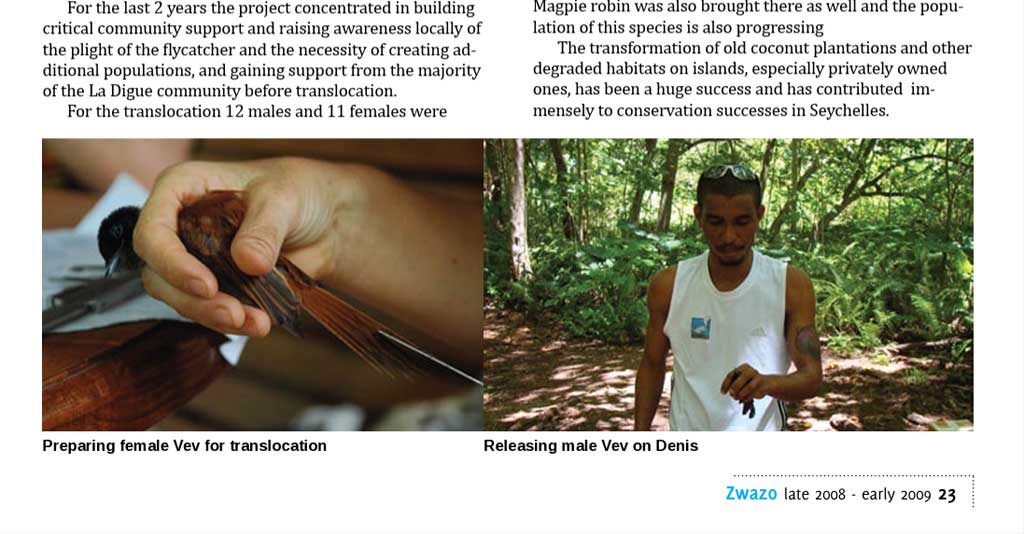
Seychelles Paradise Flycatcher translocation in Zwazo magazine
Twenty-three flycatchers were transferred to Denis in November 2008. They bred, and the new population grew beyond our initial expectations. Establishing that additional population was crucial to reducing the risk of losing the species. In 2020, the Seychelles paradise flycatcher was downlisted from “Critically Endangered” to “Vulnerable” on the IUCN Red List. Mickey and Kathleen deserve lasting recognition for making Denis available and supporting the restoration that helped make this possible.
Much has rightly been said about Mickey as a tourism pioneer with Kathleen, who remains a stalwart of the industry. I want him remembered just as clearly as a pioneer of conservation. We do too little to recognise some of the people who made the early work possible. Without Mickey and Kathleen’s collaboration, we could not have established those populations of endangered birds on Denis. His photograph deserves a place on any wall honouring Seychelles’ environmental pioneers.
For me, that contribution will always be inseparable from the man who came to our house ate and laughed heartily, cracked jokes I couldn’t understand, snorkeled with us, and later stood up to remember my father when we could no longer hear his stories ourselves.
When I think of Mickey now, I see him laughing at my comparison with a cheeky little bird, slapping me on the back. I am grateful that he and Kathleen gave endemic birds a home and that, long before that, he had been part of ours.
(Top photo: Raymond Michael Mason Masons Travel on Facebook)