
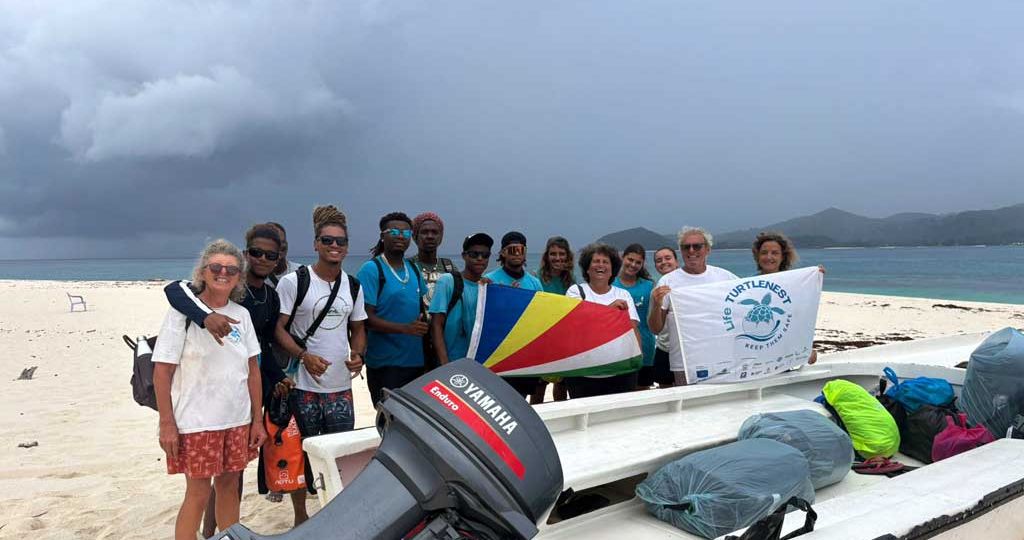
Nature Seychelles and Italy’s Legambiente Nazionale APS, the organisation coordinating the European LIFE Turtlenest project, last year launched an exchange program designed to bolster global sea turtle conservation. This collaboration allows staff from both organizations to benefit from immersive, in-the-field knowledge and experience across two different ecosystems.
The LIFE Turtlenest project is dedicated to protecting the Loggerhead turtle (Caretta caretta) by tackling threats in Italy, Spain, and France, safeguarding emerging nesting sites, and ensuring successful reproduction in the Mediterranean. In contrast, Cousin Island Special Reserve is a crucial nesting site for the Critically Endangered Hawksbill turtle (Eretmochelys imbricata). Turtle monitoring on this island has been ongoing since 1972, making it one of the longest-running programs of its kind globally. A few Green turtles (Chelonia mydas) also nest on the island.
To kick off this exchange, three members from the LIFE Turtlenest project joined Nature Seychelles’ Hawksbill Turtle Conservation Programme in December 2025. Tatiana Segnini, Enrico Michelon, and Isa Tonso received hands-on training in sea turtle monitoring, following the well-established protocols used on Cousin Island.

Chris Tagg, the island’s Conservation Officer who led the training, shared that the group was passionate and driven. They were fortunate to see both nesting females and nest hatches as well as participate in patrols and translocations.
“Our experience on Cousin Island was fantastic, both from a scientific and a human perspective, all within an extraordinary natural setting,” says Isa. “We learnt a great deal about turtle behaviour, thanks to the opportunity to observe them during daylight hours. We had a fruitful exchange of experiences and techniques with the science officer, the team of volunteers, and the rangers who lovingly care for the reserve. “Since the three of us also live on an island protected by a National Park, it was very interesting to compare the two different realities and conservation techniques,” she added.
“I am very pleased about this exchange with Nature Seychelles. It is a concrete opportunity to strengthen the sharing of information, data, and experience gained in different ecological contexts facing similar conservation challenges,” said Stefano Di Marco, Head of the Project Office at Legambiente and Project Manager of LIFE Turtlenest.
“Direct cooperation between our teams enhances technical skills, improves monitoring protocols, and helps build a stronger international network for sea turtle conservation. Initiatives like this are essential to ensure coordinated protection of nesting sites and achieve lasting results.”

A reciprocal exchange is being planned for Seychelles to take part in the nesting and hatching season of the Loggerhead turtle between June and September.
Depending on the level of competence and training, participants are expected to take part in various turtle monitoring and data collection activities, as well as take part in training, awareness-raising, and outreach activities addressed to tourists, local communities, and economic operators.
“While thousands of miles separate our shores, the language of conservation is universal. Our goal is to share not just knowledge about conservation but also create some wonderful memories together,” shared Dr. Nirmal Shah, Chief Executive of Nature Seychelles.
There are seven species of sea turtles around the globe: Flatback, Green, Hawksbill, Leatherback, Loggerhead, Kemp’s Ridley, and Olive Ridley. Green and Hawksbill turtles’ nest in the Seychelles islands, while Loggerhead, Leatherback, and Olive Ridley turtles can be seen.