
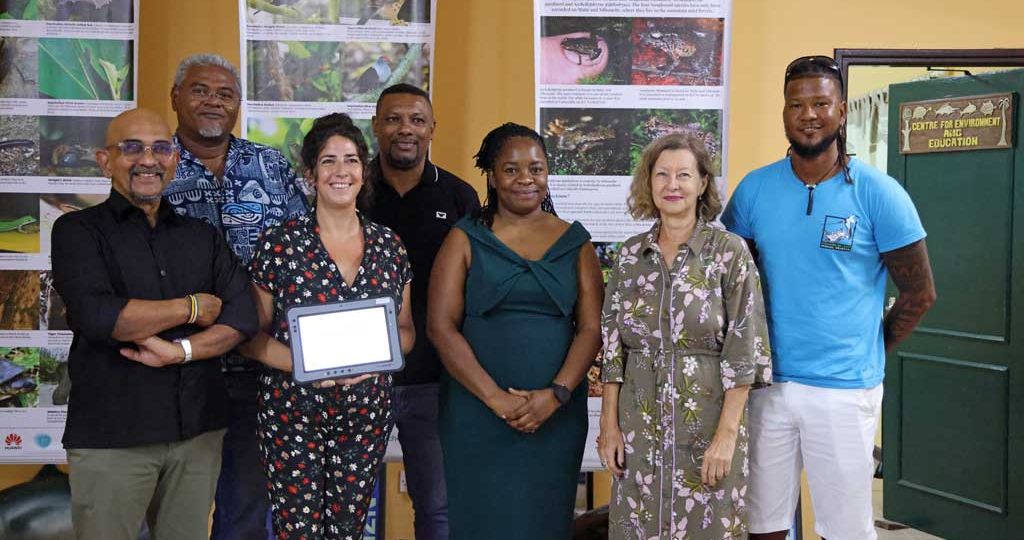
Nature Seychelles launched the App for Reserve Management (ARM) on Tuesday, 4 November, transforming conservation efforts on Cousin Island Special Reserve. The creation of the app was financially supported by the Seychelles Conservation and Climate Adaptation Trust (SeyCCAT) through the Blue Grants Fund.
Dr Nirmal Shah, the Chief Executive of Nature Seychelles, described the launch as “another historic milestone by Nature Seychelles for conservation in Seychelles.”
“Today, we’re unveiling something truly exciting and innovative,” Dr Shah said. “This is the first digital tool of its kind, specifically tailored for the Special Reserve.”
Dr. Shah, who has been toying with the idea of such an app for some time, said that the app is part of Nature Seychelles’ broader Smart Island initiative, which aims to integrate technology into conservation efforts.
“Since the onset of COVID-19, we’ve been exploring how technology can enhance our conservation work, especially with limited human resources,” he explained. “There’s a fantastic opportunity for us to utilise and even co-create technology right here in Seychelles, and this app is a prime example.”

Before the launch, Cousin Island relied on pen and paper for data collection, which Shah described as “19th Century” and was labour-intensive and prone to falsification and errors. The new app simplifies this process by automating data collection, generating reports, and helping staff track trends, enabling quicker decision-making in conservation management.
Jessica Nasica, the brilliant data scientist who was given the task of co-developing the idea into a full-fledged digital tool showcased its impressive features. She said that the app was designed with four key principles in mind: offline functionality, efficiency, automation, and adaptability to various devices.
The app is used to collect data on wildlife, illegal activities, and habitat conditions. Its “smart forms” guide users through each step to minimise mistakes, while real-time weather and tide updates are provided for vital activities such as turtle nesting. The app also manages schedules for patrols and field activities.

“We aimed to create one app that does it all – a single digital tool that streamlines and connects all conservation efforts,” Nasica, who was embedded with the Reserve team for several months to understand the needs and limitations, explained. “It saves countless hours on data entry and reporting, boosts accuracy, and speeds up decision-making.”
Staff and volunteers on the island undertook rigorous training on its use and spent hours testing the app, providing valuable feedback for its refinement. The app officially launched for daily use in November 2025. Additionally, five rugged tablets designed for tough field conditions were acquired.
“It resonates with a new generation of conservationists and makes fieldwork more interactive, efficient, and enjoyable,” Nasica shared.
The ARM app brings a host of other exciting features like real-time tracking, automatic backups, encrypted data protection, and multi-level access control tailored for users, superusers, and administrators. It even tracks the number of steps taken during patrols, creating a digital record of conservation efforts and staff activities.

Nature Seychelles plans to enhance the app with other features, including AI-assisted reporting, GPS tracking for tortoises, and drone integration to monitor habitats. A “light” mobile version for urgent reporting of turtle nesting, illegal fishing, and trespassing on mobile phones is also under development.
The most significant impact of the app has been the time saved on data management, allowing staff to focus more on hands-on conservation work.
Christopher Mahoune, the chief warden on Cousin Island, shared his thoughts:
“Now, I can dedicate more time to actual conservation, and even catch a bit more rest. This app truly transforms how we operate.”
“This is conservation reimagined – smart, seamless and born in Seychelles,” Shah concludes.