
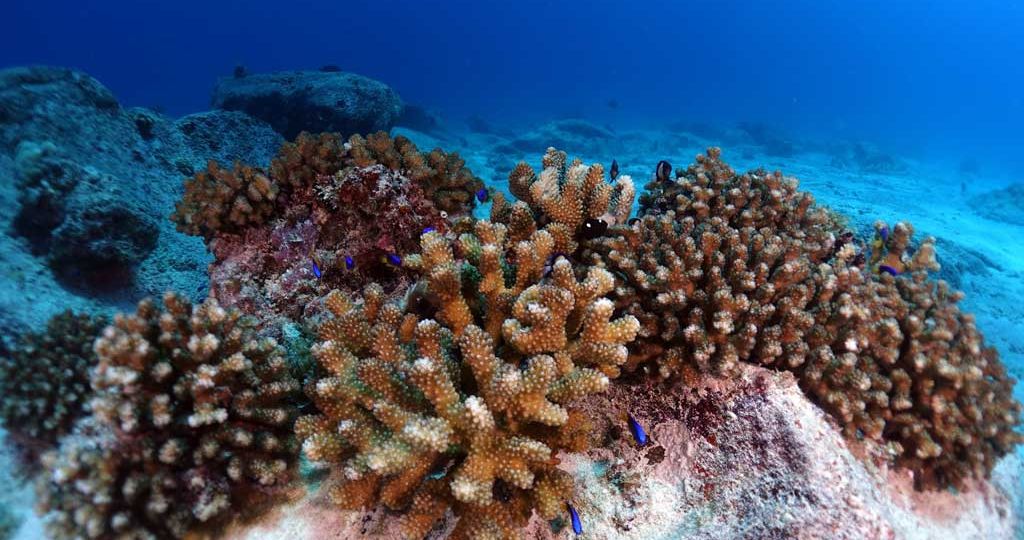
Nature Seychelles is proud to announce a landmark milestone of its coral reef restoration program, the Reef Rescuers: the successful revival of a full hectare of coral reef at the Cousin Island Special Reserve. This record-breaking achievement is a result of a dedicated four-year effort by Nature Seychelles under the regional project, “Restoring Marine Ecosystem Services by Restoring Coral Reefs to Meet a Changing Climate Future,” funded by the Adaptation Fund through UNDP and the Government of Seychelles.
The first iteration of the project funded by USAID ran for 10 years, grew over 50,000 coral colonies, and restored degraded reef areas around Cousin, Felicite, and Praslin islands.
The newly restored reef under the current project spans three areas within the reserve, which had suffered from repeated coral bleaching and the growth of macroalgae – factors that led to a significant decline in biodiversity over the years.
Achieving this milestone took an incredible amount of commitment. Over the course of the four years, the team went on an impressive 1,210 dives and spent 64,101 minutes underwater carrying out activities that involved coral collection, nursery upkeep, and outplanting. In total, more than 32,000 coral fragments were planted across the three sites.

The reef rescuers went on impressive 1,210 dives and spent 64,101 minutes underwater carrying out activities
The species used in the restoration belong mainly to the genera Acropora, Pocillopora, Stylophora, Pavona, and Psammocora – representing between 15 and 20 species in total. The vast majority (80%) were grown in mid-water floating nurseries before being outplanted onto the reef. Additionally, around 2000 corals from 12 genera were cultivated in the Assisted Recovery of Corals Facility – the first-of-its-kind land-based coral aquaculture facility recently opened in Praslin. The first 200 corals from three genera (Acropora, Pocillopora, and Galaxea) from this nursery were also successfully outplanted to Cousin.
“Restoring one hectare of reef, the size of about one and half football fields, is not just an ecological milestone, it is a statement of belief. A belief that even in an era of climate uncertainty, determined people can reverse decline, rebuild resilience, and give nature a fighting chance. At Cousin, we have not simply planted corals and restored reefs; we have planted hope and restored faith,” says Dr. Nirmal Shah, Nature Seychelles’ CEO.
“We are very thrilled by this outcome. I can look at colonies that I personally outplanted in 2022 and see them today, in 2026, massive, having survived the 2024 bleaching event, attracting fish and invertebrates, and giving life back to the reef,” says Dr Luca Saponari, the project’s Senior Science & Technical Field Officer.
The project has not been without setbacks. The fourth global mass bleaching event in 2024 resulted in an overall 40% mortality rate among both outplanted and natural corals, and macroalgae overgrowth has presented an ongoing challenge.
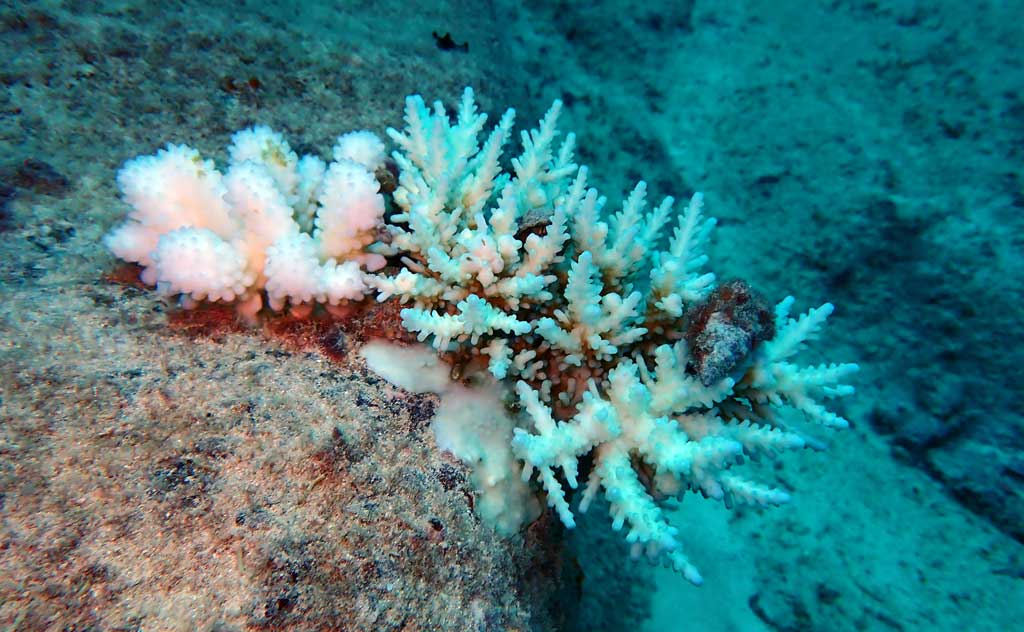
The fourth global mass bleaching event in 2024 resulted in an overall 40% mortality rate
Despite this, monitoring continues and signs of ecological recovery are clear.
The team tracks success through various metrics including coral growth and health assessments, recruitment of new corals, fish and invertebrate diversity and abundance, sightings of elusive species and megafauna, and three-dimensional reef structure analysis to track changes over time. This not only demonstrates success but also increases ecological knowledge and guides the implementation of actions to continuously improve the approach.
“Damselfish were among the first to colonize the branching outplanted corals, followed by invertebrates including crabs, brittle stars, snails, and sea stars. Key functional fish groups – grazers and predators – have also increased in number. However, stable and resilient biodiversity takes time to establish,” says Luca.
Encouragingly, the outplanted corals are showing signs of being ready to reproduce.
“Most of the fragments we used came from adult colonies, so they were already sexually mature when we outplanted them,” Luca explains. “But spawning doesn’t happen right away; the outplanted corals need to overcome the initial stress from the restoration efforts. How long that takes can vary depending on the species, until the conditions are just right for spawning. The heartening part is that we’ve found eggs in the outplanted corals and observed ex-situ spawning happening in the coral spawning lab. So, we can confidently say that our outplanted corals are ready to spawn when the conditions are favourable, achieving one of the most important ecological objectives of restoration: helping the reef recover its natural cycle.”
The restoration project involved a core team of 5 staff assisted by volunteer scientific divers at different stages.
“This milestone really fuels our motivation to keep pushing forward. It’s tough to spend hours underwater, pouring all your energy into saving the reef, only to watch it all disappear because of a bleaching event. But seeing the corals thrive and the reef come back to life is the ultimate reward,” Luca concludes.