
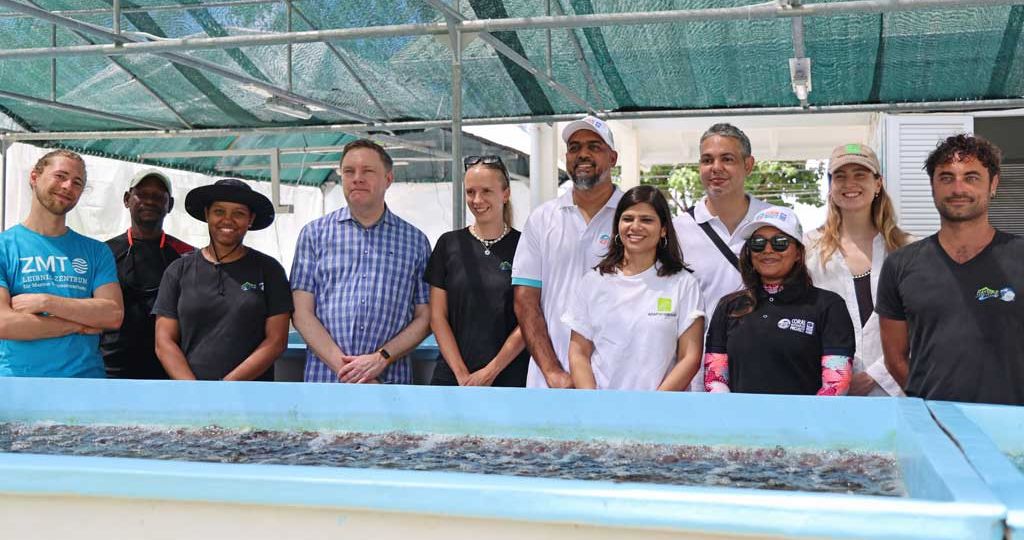
A delegation from the Adaptation Fund on a Project Monitoring Mission (PMM) to Seychelles this week visited our Reef Rescuers project on Praslin Island. The Adaptation Fund financed the regional initiative, “Restoring Marine Ecosystem Services by Rehabilitating Coral Reefs to adapt to a changing climate,” being carried out in Seychelles and Mauritius with the UNDP. Project partners in Seychelles are the Government of Seychelles, Nature Seychelles, the Seychelles Parks and Gardens Authority (SPGA), and the Marine Conservation Society Seychelles (MCSS).
This visit marked the first time the Adaptation Fund has visited project sites in Seychelles, bringing together project and technical experts from the Fund along with representatives from UNDP Mauritius and Seychelles. The main goal was to see first-hand the real-world impacts of the project and how these efforts have translated into tangible benefits for both communities and ecosystems, before the team heads to Mauritius and Rodrigues to connect with project partners there.
The delegation’s first stop was at Nature Seychelles’ CORAL Building, which is home to the Assisted Recovery of Coral (ARC) facility – the first large-scale land-based coral aquaculture facility in Africa. This facility was funded through the project with additional backing from SeyCCAT and CMA CGM.
Dr. Luca Saponari, the Senior Science & Technical Field Officer at Nature Seychelles, shared insights on the project’s successes as well as the very real challenges of restoring reefs in an ocean that is becoming increasingly warm.
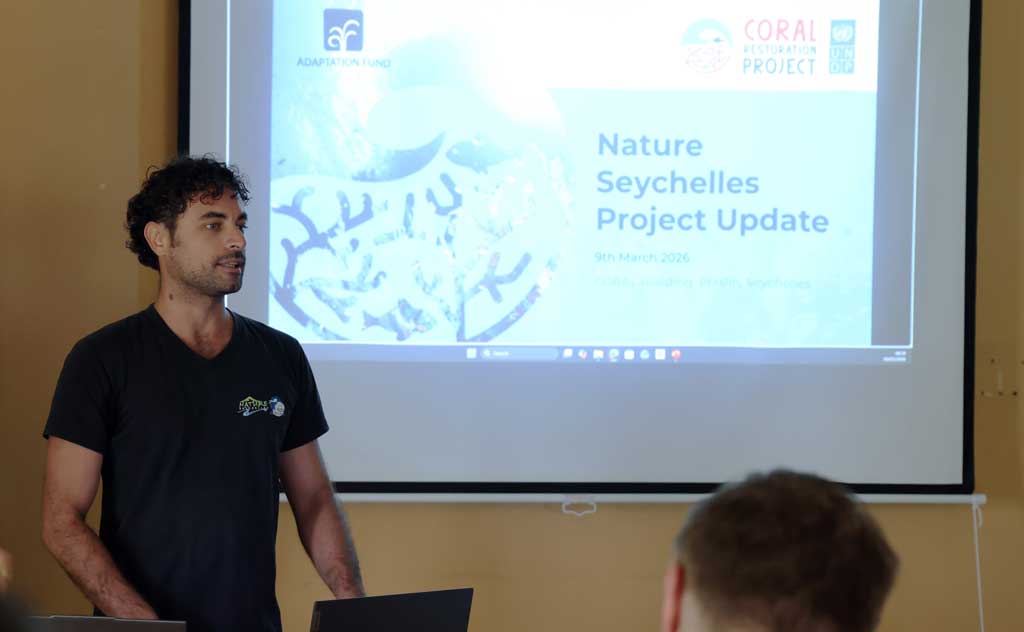
Dr Luca Saponari shared the project's successes as well the challenges
Since 2021, the progress has been nothing short of impressive: over 50,000 coral fragments nurtured in ocean-based nurseries, more than 32,000 corals successfully planted to rejuvenate a full hectare of reef at Cousin Island Special Reserve, and over 60 individuals trained in coral restoration techniques.
The building of the ARC introduced a novel technique known as micro-fragmentation to cultivate thousands of coral fragments in a controlled environment. With the ability to grow up to 10,000 fragments each year, it is currently nursing 2,000 coral fragments in a controlled environment. It also serves as a gene bank for rare and resilient species and is home to the first ex-situ coral spawning laboratory in the Western Indian Ocean, built with support from Canon and Coral Spawning International (CSI). Teaming up with experts from CANON and CSI, the project successfully documented the first-ever ex-situ coral spawning in Seychelles and the region, advancing coral reef restoration beyond traditional reef gardening.
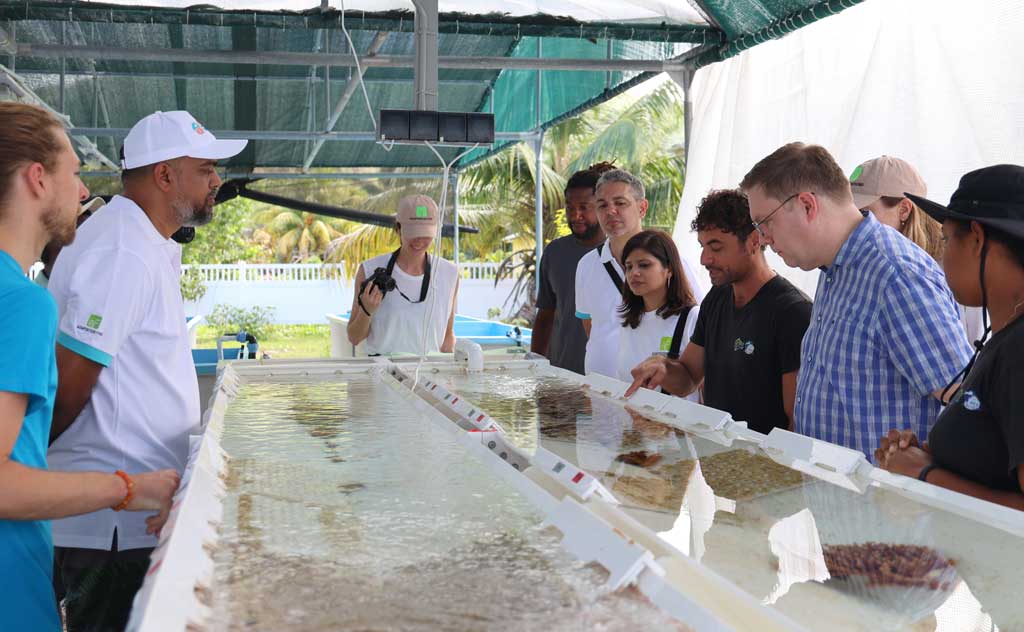
The establishment of the ARC and introduction of a spawning lab were key impacts
Other project impacts included a partnership with Raffles Hotel to restore an area of reef at Anse Takamaka in Praslin, with training provided to staff and a manual produced, research collaborations with universities, research papers published, participation in local, regional, and international symposia, extensive media coverage, and outreach to schools and community, and visits to ARC.
Even with significant challenges, including the global coral bleaching in 2024 / 25 that led to considerable coral loss and paused all in-water activities for several months, the project has still managed to hit up to 98% of its goals by the beginning of 2026. What’s been established here is a top-notch restoration model that can serve as a blueprint for the broader Western Indian Ocean region to learn from and expand upon.
The Adaptation Fund’s monitoring mission serves as a timely reminder of what effective climate finance can achieve, asserted Nature Seychelles’ Chief Executive Dr Nirmal Shah.
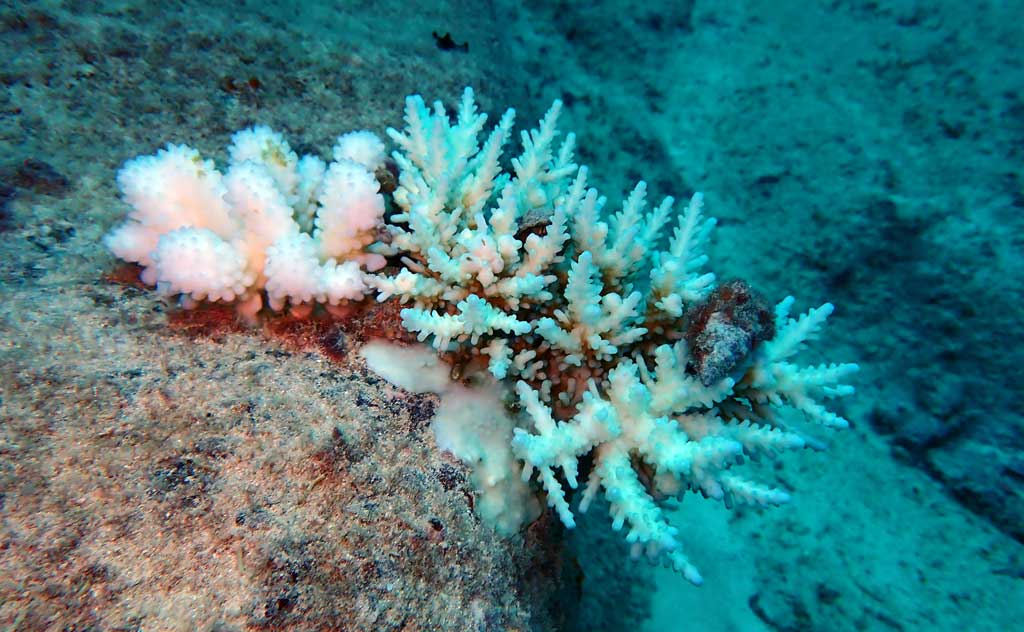
The 2024/25 global mass coral bleaching negatively impacted the project
“Their support has been truly remarkable. With this support, innovative reef restoration techniques, stronger scientific monitoring, and expanded field operations have become possible. These efforts are helping to rebuild damaged reefs, strengthen coastal resilience, and safeguard marine biodiversity that communities depend on,” he said.
The biggest challenge is now long-term investment to continue with the project. This progress and years of hard-earned expertise, data, and institutional knowledge could be lost just when we need to ramp up our efforts in the face of worsening climate impacts.
“Strategic investment from the Adaptation Fund has transformed coral restoration in the Seychelles from a bold vision into a high-impact reality,” Dr Shah explained. “The funding was the catalyst for landmark achievements that have set a new standard for the region. Our success proves that the methodology works; however, the scale of the climate crisis requires sustained, long-term investment. To protect the biodiversity and coastal economy of the Seychelles, we must now scale these “proven wins” and we need more money to do that.”