
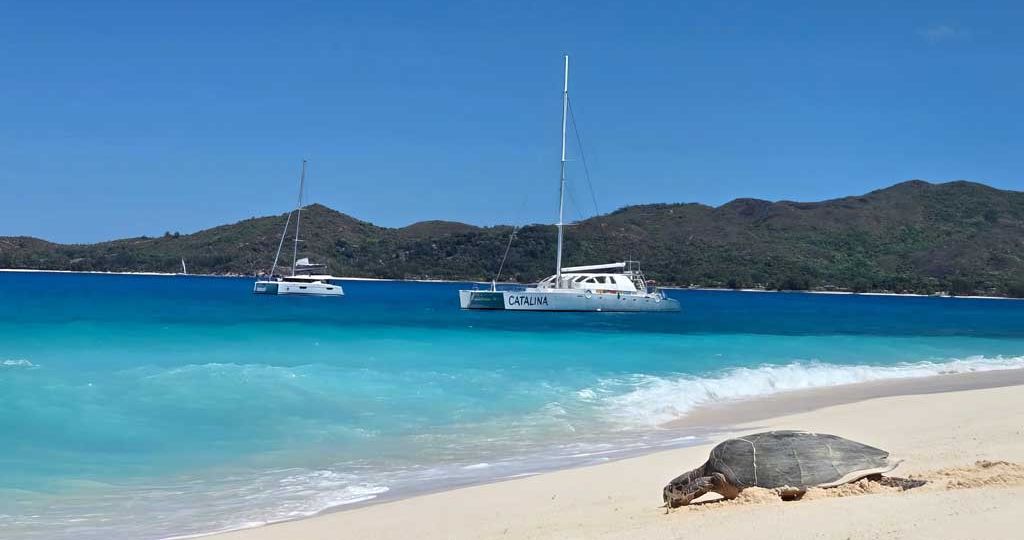
Hawksbill turtles nesting season has picked up on Cousin Island Special Reserve, despite a slower start this year compared to last.
On the Special Reserve, the “Turtle Team” – a dedicated group of trained staff and volunteers – takes charge of monitoring the turtles from October to March. Their mission is to collect data on female turtles, which is crucial for making informed conservation decisions regarding this still critically endangered sea turtle that makes annual forays to our shores to nest. This makes the Turtle Team’s role both vital and meticulously organised and managed.

New team members, whether staff or volunteers, undergo training in turtle monitoring based on a long-term protocol. The training focuses on accuracy, care, and respect for the turtles. They learn how to patrol the beaches looking for turtles, tracks or nests, document turtle activity, and safely tag turtles for identification.
Each nesting turtle that visits Cousin gets tags on its front flippers. During monitoring, the team looks for existing tags, including those from other locations in Seychelles, or applies new tags when they encounter an untagged turtle. When done correctly, these tags can last for decades, sometimes throughout the turtle’s entire life. The team practices tagging under the conservation officer’s supervision several times before they do it on their own.
They are also taught to recognise each stage of a turtle’s nesting behaviour, which is essential for gathering the right data without causing stress to the turtles.

The nesting process begins when a female turtle cautiously emerges and makes her way from the ocean. She moves slowly, often stopping to scan the beach. If she feels threatened, she might head back to the water. Once she’s fully on land, she moves in an alternate gait while navigating around obstacles like rocks or logs until she finds the perfect spot to nest, usually close to some vegetation.
Next, she does what is known as body pitting, where the turtle clears away any vegetation and debris.
She then used her hind flippers to dig a hole about 30 to 50 cm deep. This is a delicate phase; if she encounters roots or rocks that prevent deep digging, she may abandon the site entirely to search elsewhere. The team can tell this stage by the smell of disturbed sand or soil, the sound of her flippers against her shell, or observing her movements.
Once the nest is ready, the turtle takes on the laying position, with her head in the sand and her rear flippers on either side of the hole. She lays anywhere from 50 to 230 eggs, usually in small batches, with very little movement. This is the moment when the Turtle Team gathers data and applies tags.


After laying her eggs, the turtle fills the nest back up with sand using her rear flippers, then camouflages it by tossing sand over the site with her front flippers. Finally, she turns towards and makes a swift return to the ocean.
The team also learns to identify when turtles abandon their nesting attempts, whether it’s before they reach the nesting spot or after they’ve started digging. This can happen due to disturbances, obstacles, or other unknown factors.
And thanks to SeyCCAT (Seychelles Conservation and Climate Adaptation Trust), all this meticulous data collection is now done using the island’s recently launched App for Reserve Management (ARM)!