
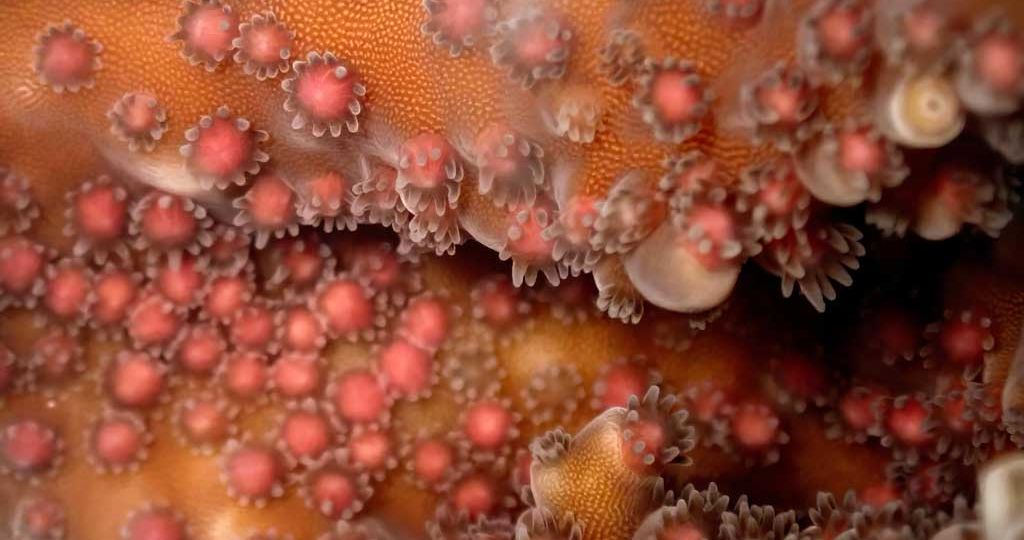
During Seychelles’ first-ever land-based coral spawning at our Assisted Recovery of Corals (ARC) facility on Praslin Island, the Nature Seychelles’ Reef Rescuers team witnessed corals releasing their gametes right before their eyes. This milestone was made possible thanks to the NGOs’ collaboration with CANON and Coral Spawning International. CANON funded the spawning lab and provided imaging equipment, while Coral Spawning International built the lab and conducted training in land-based coral spawning. Here, in their own words, are the team’s genuine reactions as they experienced coral reproduction up close for the very first time.

Luca Saponari, the team leader, described the event as both a lifetime “core memory” and a fundamental breakthrough for the Nature Seychelles restoration project – one that allows the NGO to move forward in the race to help coral reefs. “Coral reproduction has been a mystery for many years, and understanding the corals’ spawning cycle and the cues that trigger them is a key component of coral conservation and restoration efforts. Thanks to the restoration projects around the world, we are unlocking this mystery. Here in the Seychelles, we witnessed ex-situ spawning for the first time in the western Indian Ocean region. It was an incredible experience, considering that this event occurs only when the right conditions are met at the same time,” he says.
For Priya Didon, the coral aquaculture officer, the spawning was both “mesmerising” and “surreal”. “However, the most exciting part is watching the different stages of egg development and their journey into the larval stage – where they start swimming as they choose a suitable spot to settle and grow on,” she says.

Viktoria Sturm, the science and technical field officer, described the experience as beautiful and said it was a privilege to see it happening at last at ARC. “We actually expected the spawning to happen the night after. So, when someone screamed, ‘the corals are spawning!’ we all ran to the tank where it was happening,” she explains. “It’s such a beautiful process, and seeing it for the first time makes me very grateful. It also gives me a lot of motivation for the future of ARC and the reefs here in Seychelles, because it will significantly increase the number of genetically diverse corals and thus more resilient restored reefs.”
Three volunteer scientific divers supporting the restoration efforts were also present during the spawning.

“It was truly magical! Witnessing corals simultaneously release bundles of gametes in the dark has completely changed my perspective on how these complex organisms work and sparked further curiosity in their spawning behaviour across different species,” exclaims Carmen Law.
On her part, Olga Tucakov said the spawning was something she always wanted to witness, but when they all started releasing the bundles at the same time, it was “really cool.” Mostly, she was grateful to see it.
Finally, Aidan Hillel said the experience was absolutely amazing. “To witness something so rare made me feel so lucky! And to be surrounded by so many passionate experts in the field made the experience even more enriching,” he concludes.