
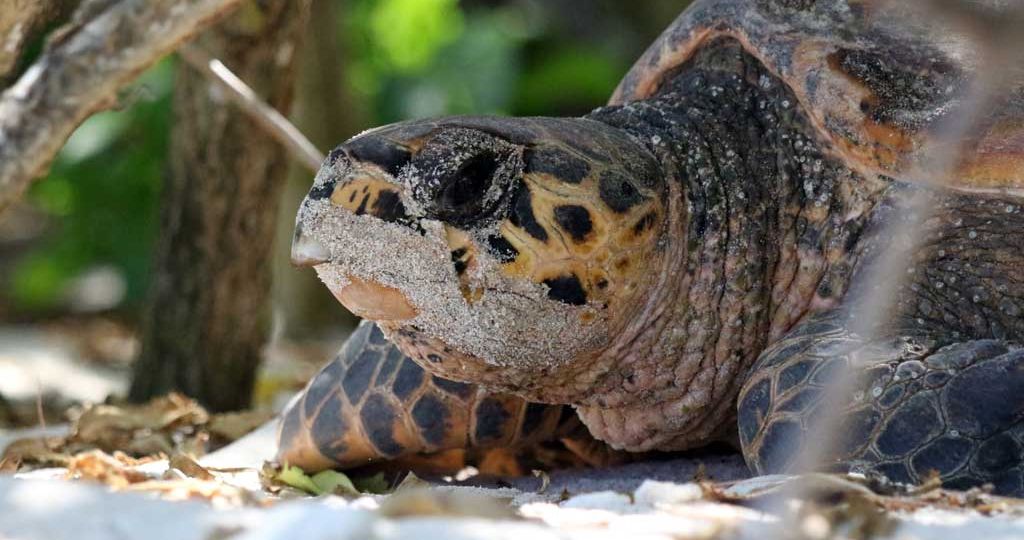
It’s Hawksbill turtle nesting season once again with females coming ashore to nest around our islands!
The Hawksbill turtle (Eretmochelys imbricata, kare) is one of the sea turtle species that nest in Seychelles, the other being the Green turtle (Chelonia mydas, torti-d-mer).
One of the smaller sea turtles, Hawksbills can easily be identified by their patterned, serrated shells with overlapping scutes – once the target of trade in turtle shells – and their distinctive pointed heads with beak-like mouths, which give them their name. They have two visible claws on each front flipper. Crawling with an alternating gait, they leave asymmetrical tracks on the beach in sharp contrast to the green turtle, which has a more symmetrical gait and tracks.

Do not touch hatchlings (Photo - Hugo Bret)
The females reach maturity around 20 to 30 years old. They migrate to their natal beaches every two to three years to lay their eggs. They may make the journey ashore up to six times in a single season and lay an average of 100 to 160 eggs. They leave their eggs behind, which will hatch after about two months, with the newborn hatchlings making their way to their ocean on their own.
Nesting occurs during daytime in Seychelles, unlike in other global locations. Between October and March, there’s an opportunity to see this fascinating turtle on our beaches.
Conservationists will be collecting crucial data for the species. Studying sea turtle populations presents a unique challenge as they spend most of their lives in the ocean; therefore, scientists rely heavily on long-term monitoring of female turtles at their nesting beaches. Data collected includes each turtle encountered, the type of nesting activity, track and shell measurements, and tag numbers. Titanium tags are applied to the females’ flippers in Seychelles to help identify them. They have a three-letter code followed by 4 digits.
While it is exciting to see turtles during nesting season, it is important to remember to give them space to do what they have come to do. Turtles on land are wary and will abort nesting when disturbed.

Keep nesting beaches clean
Watching a nesting turtle or hatchlings is a rare privilege, so we need to do it responsibly. Do so quietly and at a distance. Stay behind them; don’t enter their line of sight, rush towards, or touch them. Keep noise to a minimum. If you are taking photos, take them from afar and use zoom for close-ups. Do not use flash photography. When they are returning to the ocean, keep away and do not position yourself between turtles and the water.
Don’t touch hatchlings or pick them up and put them in the water; allow them to find their way to the ocean. It helps them imprint the beach so they can return when they are ready to lay eggs. If you want to help, smooth out the sand by raking over footprints or removing obstacles in their path. Help to keep our beaches clean and free of plastics and other litter.
During nesting season, turtles move to shallow waters. Don’t get too close or touch them while swimming or snorkelling. Don’t chase them; if a turtle swims away, let it go.
Hawksbills are listed as “Critically Endangered” on the IUCN Red List. Seychelles hosts one of the largest nesting populations of Hawksbill turtles in the world, and all sea turtles are protected by law with severe penalties in place illegal activities.