
Our wetlands are home to a magnificent and varied fauna. This week we describe four animals you can spot in wetlands.
Meet the Porcelain Fiddler Crab (Uca lactea annulipes), or ‘Krab semafot’ in Creole. This small crab is named for the white and brownish pattern on its carapace, as well as for the males having one larger foreclaw, which resembles a fiddle – believed to have evolved to attract females or defend against predators. The female fiddler crab is dark brown with equal-sized foreclaws. The Creole name describes the courtship behaviour of these crabs, where the male beats their carapaces with the claw, resembling penitents striking their chests while proclaiming the “mea culpa,” a Latin phrase meaning “my fault.” Fiddler crabs communicate by tapping or drumming on the ground. They are the most common fiddler crab species in the granitic islands. Spot them waving their giant claws from the blanket of tiny sandy balls in wetlands!
The Green-backed heron (Butorides striatus), also known as the Striated heron or ‘Manik’ in Creole, is a native bird that breeds throughout the Seychelles. They inhabit rocky shores, shallow reefs, mangrove, and freshwater marshes. Green-backed herons are highly territorial; individuals tend to patrol their stretch of shoreline or mangrove. They are also known for being clever and patient hunters, using bait to lure fish. They hunt from cover or by standing still near the edge of the water, stalking prey. Their diet is made of small fish, frogs, insects, skinks, crabs, and the eggs of other birds. They emit a loud warning call, a harsh double croak, which is often the first indication of their presence.
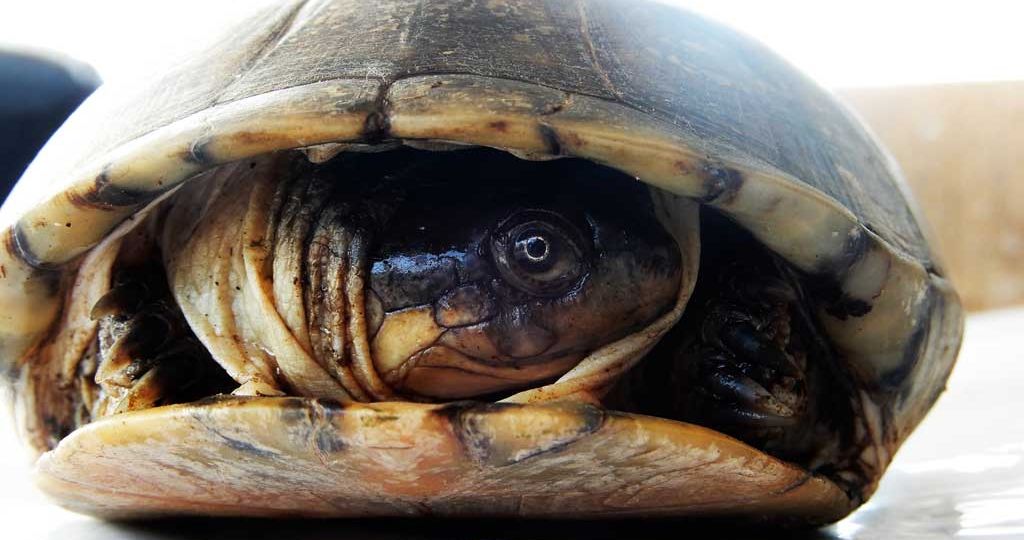
The Black Mud Terrapin (Pelusios subniger) or ‘Torti Soupap’ in Creole is rare and is listed as Critically Endangered under the IUCN Red List. It is a native endemic subspecies. At 20 cm, this is a small terrapin with a dark grey-brown carapace and yellow-grey underside with black patches. They are most active during twilight, which means they are active during the morning and evening hours, typically when the sun is low and the light is dim. Torti soupap is restricted to at least 6 granitic islands of the Seychelles – Mahe, Silhouette, Cousin, Cerf, Fregate, and La Digue. They could be present on other islands, too. Try spotting them at the Northeast Point or Grand Police Wetlands. They have a hinge on the underside of the shell that allows them to retract the head and forelimbs, closing the shell for protection, so you might think you are just looking at a rock!
The Mangrove Whelk (Terebralia palustris), also known as the Mud Creeper or ‘Fizo’ in Creole, is the only species of brackish-water snail found in Seychelles. Its long, conical shell can range from brown to greyish, sometimes with lighter or darker markings. They are found on coastal mudflats, the surface of mud in mangroves, and soft, waterlogged soil. They are a truly amphibious species, capable of searching for food during low and high tides. They are major grazers in the mangrove habitat and play a vital role in the wetland ecosystem by breaking down organic matter. As burrowers, they also contribute to oxygenating the sediment, improving the habitat for other organisms living in the mud. Hermit crabs often use the empty shells of mangrove whelks as their homes. Fishermen often harvest mangrove whelks to use as bait. Want to spot them? Listen closely for their unique popping sound.