
The world’s coral reefs are running out of time to recover between increasingly frequent marine heatwaves and coral bleaching events driven by climate change, according to the Status of Coral Reefs of the World: 2025.
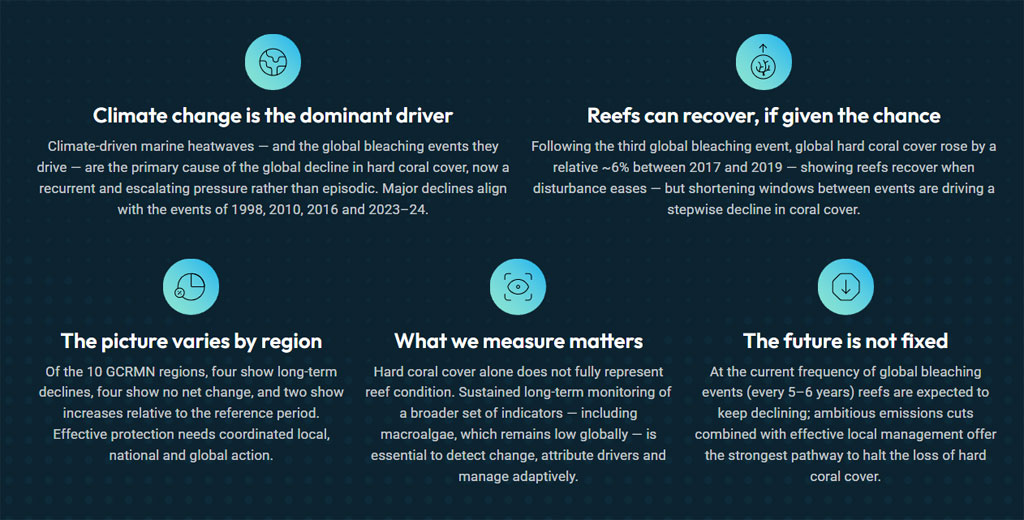
Released by the Global Coral Reef Monitoring Network (GCRMN), the report reveals that between 1980 and 2024, the global hard coral cover has dropped from an average of 30.2% (based on data from 1980 to 2009) to just 27.3% (from 2020 to 2024). This marks a significant decline of about 9.5%. The main cause is climate change-induced heat stress.
Crucially, the GCRMN highlights that while coral reefs have a natural ability to bounce back when given a reprieve, this resilience is being steadily eroded. Disturbances that used to happen roughly every ten years are now occurring every five to six years, leading to a troubling pattern of long-term decline.
“After decades of studying coral reefs, what concerns me most isn’t the current loss of hard coral cover; it’s that we’re steadily eroding the conditions they need to recover,” said Dr Manuel González Rivero, lead author.
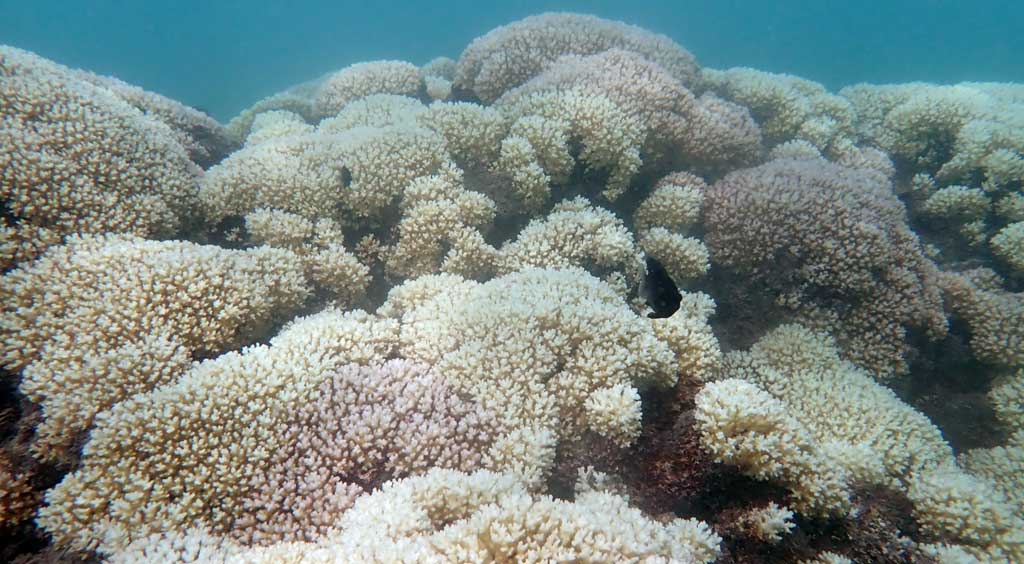
Coral bleaching, Seychelles
“Coral bleaching is a stress response,” explains Dr Nirmal Shah, Nature Seychelles’ Chief Executive.” When ocean temperatures rise too high, corals expel the tiny algae that live in their tissues that supply corals with their energy and give them their colours. Without these algae, corals lose this colour and look ‘bleached’.”
But bleached doesn’t mean they’re dead. If conditions improve, they can recover. However, bleaching takes a toll; prolonged or severe heat stress can lead to coral death.
“The surviving corals need time to bounce back. So, when the next major bleaching event hits before this recovery, the reef is left in a weaker state to face the challenge,” Dr Shah says.
The GCRMN report shows that globally, hard coral cover increased by 6% between 2017 and 2019 following the third global bleaching event. But that recovery was partial, and the fourth global bleaching event has since reversed much of that progress.
The report is based on over 40 years of global data, pulling from 21.1 million observations, 87,299 surveys, and 36,886 sites across 124 countries, territories, and economies, making it the most comprehensive assessment of coral reef status ever produced.
Key findings
Source: Status of Coral Reefs of the World: 2025.
September is Coral Bleaching Awareness Month
This is why awareness is so crucial. When we understand what leads to bleaching, what follows, and what can help corals come back, we see why taking action is important. Coral reefs shield our coastlines from wave energy and storm surges, and they underpin the fisheries and tourism that the economy depends on.
Coral Bleaching Awareness Month, now celebrated in September instead of November, is an opportunity to bring the science into everyday conversations. This way, more people can learn about the challenges facing coral reefs and what can be done to help coral reefs.
Reducing greenhouse gas emissions is necessary to reduce the heat stress that leads to mass bleaching. At the same time, protecting reefs from other threats like overfishing, pollution, and habitat loss can significantly boost their chances of survival and recovery. Healthier reefs are simply in a better position to endure disturbances.
Coral Reef Restoration at Nature Seychelles
Since 2010, our Reef Rescuers project has been restoring the damaged reefs around Cousin Island Special Reserve. We’ve successfully grown and outplanted thousands of coral fragments using innovative coral gardening techniques.
Now, we’re taking it a step further with ARC – Africa’s very first land-based coral aquaculture facility – with methods like micro-fragmentation to speed up coral growth in a controlled environment, and a coral spawning lab in collaboration with Canon and Coral Spawning International to study and replicate the natural process of coral reproduction.