
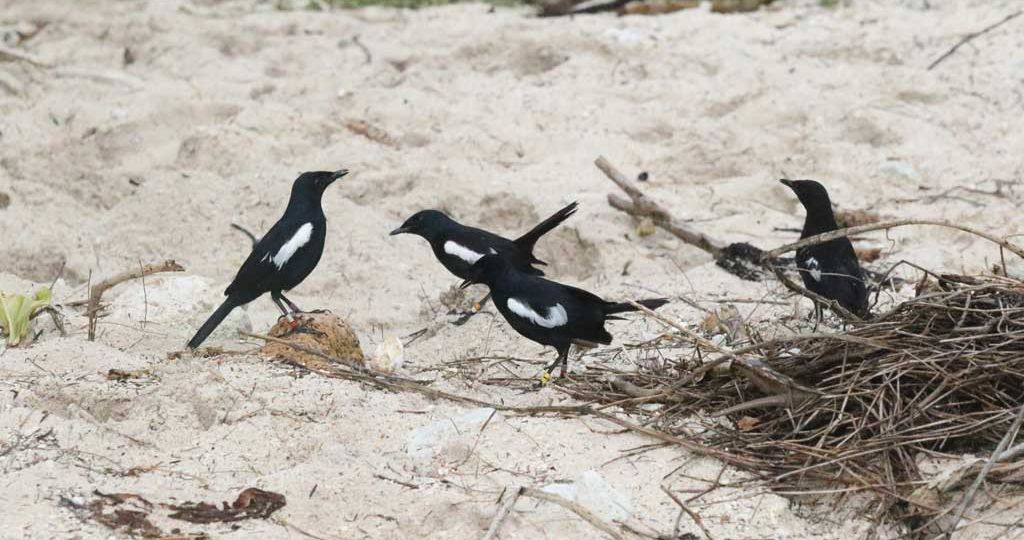
Published Field observations, authored by Nature Seychelles’ Chris Tagg and Eric Blais, have highlighted previously undocumented bird and turtle egg behaviour – an example of how careful, long-term fieldwork can uncover new ecological insights.
Imagine this: a nesting Hawksbill Turtle (Eretmocheys imbricata) has made her way up the beach on Cousin Island, carefully digging to lay her eggs. Perched on a nearby branch, a small, black-and-white bird watches. She swoops in, grabs an egg, and flies off. Meet Yellow-Yellow, one of the Seychelles Magpie Robins (Copsychus sechellarum) from Cousin Island whose story has now made its way into the spotlight.
Cousin Island Special Reserve is a crucial nesting ground for Hawksbill Turtles, where females come ashore between October and March to lay their eggs. It’s also home to a recovering population of Seychelles Magpie Robins, a bird that was once teetering on the brink of extinction.
Over several nesting seasons, our team has observed surprising interactions between these two species during standard turtle monitoring.
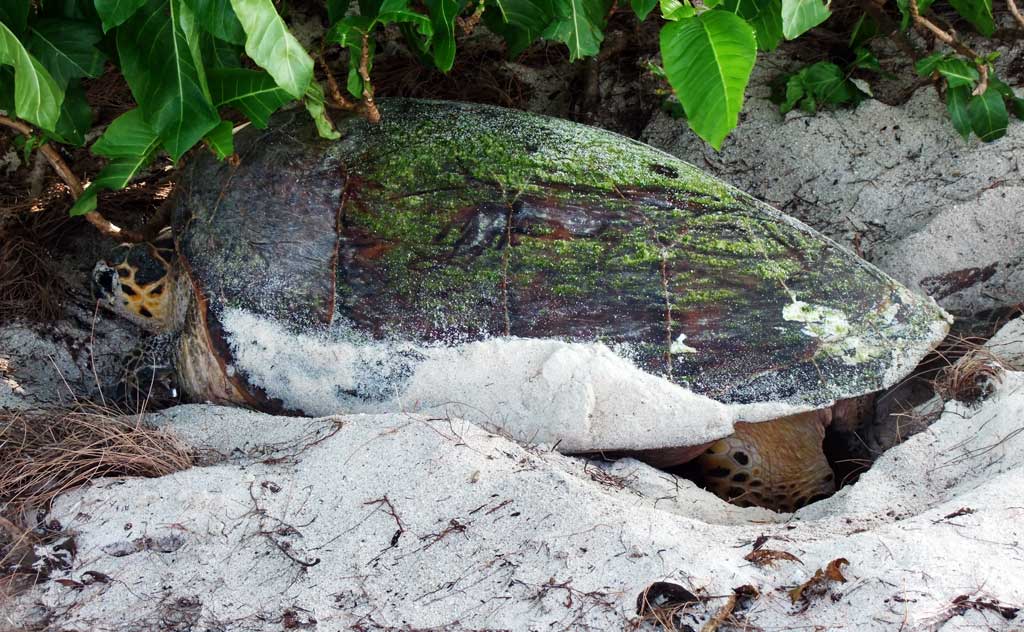
Nesting turtles are monitored to record tag IDs, count clutch sizes, and make morphological measurements. While waiting for the turtle to start laying, observers remain quietly behind her at a suitable distance to not disturb her. This allows for observations of Seychelles Magpie Robin behavior near the turtles to be noted.
The magpie robins have always been attracted to the sound of rustling leaves and disturbed soil, the same signals that lead them to follow tortoises or humans moving through the forest. As hawksbill turtles dig their nests, they stir up the soil and leaf litter, which in turn disturbs insects and other small invertebrates. This catches the attention of magpie robins, who perch nearby, eagerly foraging on the invertebrates that the turtles have uncovered.
But the team stumbled upon other unexpected behaviour. They noticed that, in some instances, the birds were actually feeding on turtle eggs that had been accidentally dug up during the nesting process. These observations were made throughout the 2023/24 nesting season, in various locations around the island.
There were six recorded observations of single Seychelles Magpie Robins or a group of Seychelles Magpie Robins feeding on eggs of Hawksbill Turtle during that nesting season. The birds targeted eggs that were already damaged.
In at least one remarkable case, however, a dominant female magpie robin was spotted piercing an intact egg to get to its contents.
Yellow-Yellow, recognised by her colour rings, was seen piercing the egg herself and enjoying the tasty insides. Her fledged chick, observing her closely, also learnt to exploit turtle eggs as a source of food.
The paper indicates that this behaviour might be something that’s learned and reinforced over time. In areas of the island where turtle nesting happens more often, magpie robins seemed to be more inclined to link turtles with potential feeding opportunities.
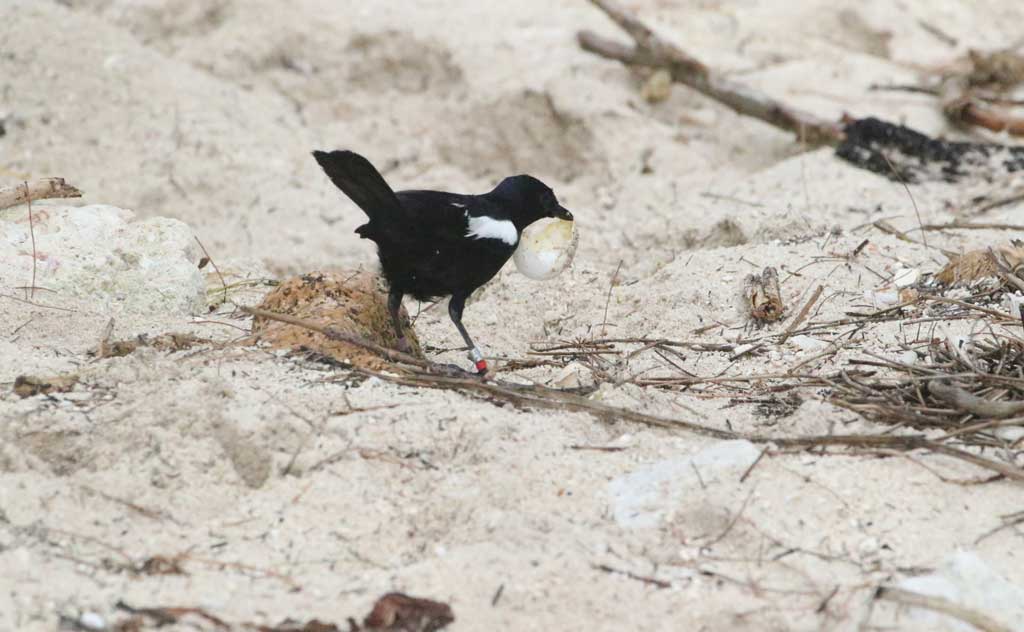
They’ve been seen chasing after skinks or crabs – the usual opportunistic raiders of nests – whenever they try to snatch an egg.
Seychelles Magpie Robins display little wariness around humans. During excavations, especially in the territory dominated by Yellow-Yellow, the birds frequently fly over and perch on nearby staff, who have been known to allow the birds to take eggs that have already been analysed.
It is possible that the birds first developed egg feeding behaviour through excavations as opposed to exploiting damaged nests, but this cannot be proved. Seychelles Magpie Robins also naturally feed on seabird eggs so a ruptured turtle egg may in itself be enough to entice investigation leading to feeding.
There’s no evidence suggesting that the birds prey on turtle hatchlings or late-stage embryos. Instead, their interaction seems to be more about opportunistically feeding on exposed eggs rather than engaging in active predation.
This behaviour showcases the adaptability of the magpie robin, a species well-known for its ability to take advantage of a diverse array of food sources in its surroundings.
The observations have now been published in the journal Biodiversity Observations: